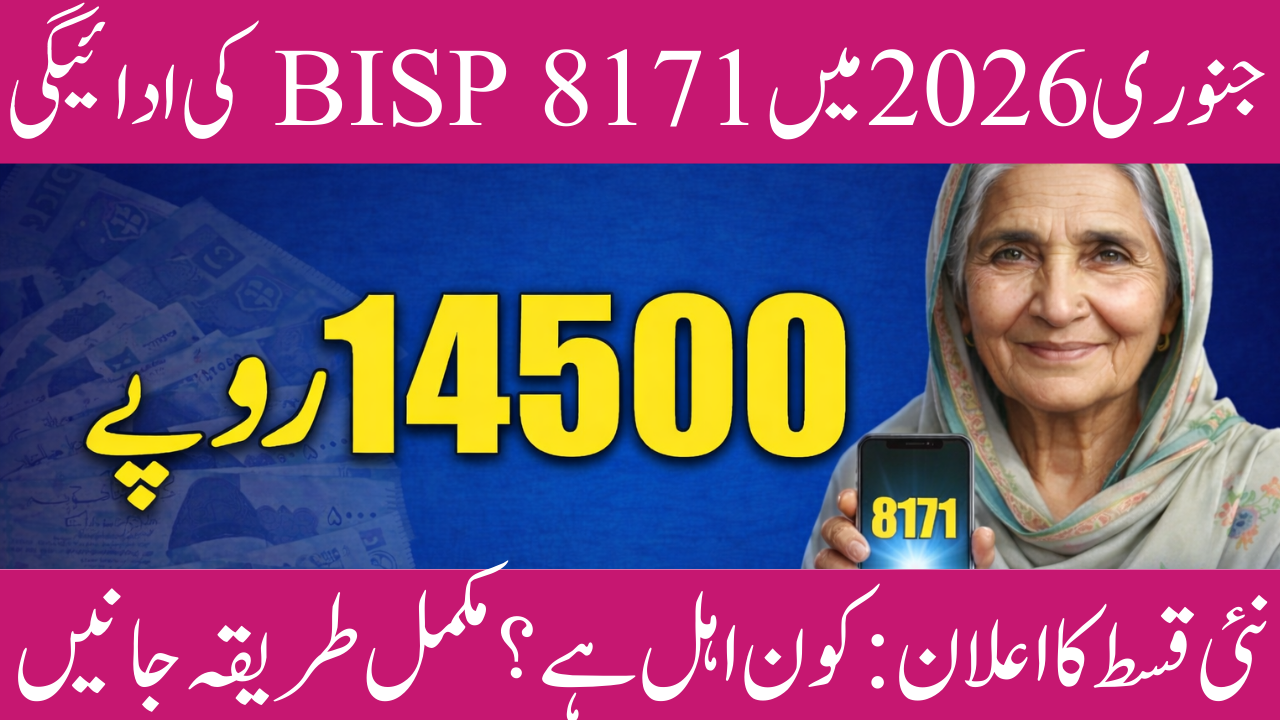
BISP 8171 Payment In January 2026
BISP 8171 Millions of beneficiaries are interested in learning more about their eligibility, registration status, and the anticipated payment of Rs 14,500. The payment in January 2026 is a vital social safety net for low-income families in Pakistan. By providing precise instructions on registration and qualifying requirements, the article seeks to dispel widespread misconceptions about payment cycles. It offers recipients helpful guidance to guarantee a seamless payment procedure, stressing preparedness and actions to reduce delays, hence reducing anxiety and erroneous expectations related to payment receipt.
You can read more: BISP Reopens Cards for Filers Across Pakistan Following Fresh Poverty Score Analysis
The Significance of the January 2026 BISP Payment Cycle
Instead of all recipients receiving monies right now, a new payment cycle will begin in January 2026. Verification and the gradual distribution of funds depend on this time frame. If monies are not immediately evident, many beneficiaries become anxious. Previous experiences have demonstrated that those who understand the payment cycle stay calm and prepared, stressing the need of keeping correct records, an active cellphone number, and a valid CNIC over compulsively scanning social media or unauthorized news.
The True Significance of the January 2026 Start Date
The commencement date signifies that the payment procedure for the new phase of the Benazir Income Support Programme (BISP) has begun. Depending on district coverage, beneficiary preparedness, and verification completion, payments are made gradually. Because of this, some neighbors in the same neighborhood can get payments sooner than others. Beneficiaries must understand that BISP does not function on a “first day for all” basis. Beneficiaries should avoid needless irritation and reduce the number of journeys to collection locations by considering the commencement date as a continuing process rather than a rigid deadline.
Comprehending the Payment Amount of Rs 14,500
For qualified beneficiaries in this cycle, the anticipated payment of Rs 14,500 is subject to the beneficiary profiles’ verified and active status at the time of payment release. Many recipients are disappointed because they think this amount is guaranteed. Considering Rs 14,500 as the cycle’s goal is a sensible approach; recipients should wait for their payment status to verify availability before budgeting. This strategy helps families reduce financial stress and manage expectations.
| Category | Details |
|---|---|
| Program Name | Benazir Income Support Programme (BISP 8171) |
| Payment Cycle | January 2026 (Phase-wise distribution) |
| Expected Amount | Rs 14,500 (for verified beneficiaries) |
| Eligibility Basis | Valid CNIC, active profile, verified household data |
| Payment Method | Biometric verification at approved centers |
| Status Check | Through official BISP 8171 channels only |
Who Is Eligible for the January 2026 BISP Payment?
- Eligibility is determined based on identity and household information rather than random selection.
- Genuine beneficiaries often experience delays due to mismatched data across systems.
- Conditions for smoother processing include:
- Valid CNIC matching BISP records
- Active beneficiary profile without pending issues
- Household data aligned with survey requirements
- Successful verification history in previous cycles
- Consistency in records is crucial for ensuring smooth payments and avoiding repeated issues.
You can read more: Good News for CM Punjab Bike Scheme Students: BOP Extends Deadline to 15 January 2026
Requirements for Eligibility That Must Stay Constant
- Payment issues typically arise from technical mismatches rather than changes in poverty status.
- Small errors, such as incorrect name spelling or CNIC digits, can prevent payment.
- Beneficiaries should take the following steps to maintain eligibility:
- Ensure CNIC details are accurate and unchanged.
- Use one permanent mobile number.
- Update household information only when necessary.
- Keep survey answers consistent.
- These seemingly minor actions are crucial for payment approval.
The Operation of the BISP Payment Schedule
Payments are made in phases, depending on operational preparedness and verification completion, rather than all at once on a single national date. Payments are made to some districts sooner than to others. To save time and avoid needless travel, beneficiaries are urged to stay organized and regularly check the status of their payments through official channels.
How to Get Ready for the Release of Payments
- Preparation reduces issues at collection points.
- Early preparation allows beneficiaries to collect funds in one visit.
- Key aspects of good preparation include:
- Keeping your original CNIC safe and valid.
- Keeping your registered mobile number active.
- Avoiding unnecessary SIM changes.
- Following official updates only.
How to Get Rs 14,500 Step-by-Step
- The payment collection process is straightforward when properly followed.
- Skipping verification or rushing can lead to issues.
- Key steps in the process include:
- Checking payment availability via official channels.
- Visiting an approved collection point.
- Completing identity verification.
- Confirming the displayed amount.
- Retaining the receipt or confirmation message.
- Adhering to these steps safeguards both the payment and the user’s record.
Methods of Verification Employed in BISP Payments
In order to prevent fraud and misuse and guarantee that money is paid to the right beneficiaries, verification is crucial. Typical verification techniques include registered number checks for validity, biometric verification at collecting locations to avoid unwanted access, CNIC data matching for identity confirmation, SMS confirmation for contact validation, and aided verification for vulnerable beneficiaries. Every technique has a distinct function that improves the verification process’s overall integrity.
Reasons for Payment Delays
- Most delays are attributed to data-related issues rather than financial ones.
- Beneficiaries often unknowingly contribute to problems by altering numbers or providing inconsistent details.
- Common reasons for delays include:
- CNIC and name mismatches.
- Inactive or changed mobile numbers.
- Incomplete household updates.
- Dependence on unauthorized agents.
The Best Ways to Prevent Payment Problems
• Strong habits protect payments and reduce stress.
• Beneficiaries who follow these practices experience fewer long delays.
• Helpful practices include using one permanent mobile number.
• Double-check CNIC digits and name spelling for accuracy.
• Complete surveys carefully to avoid issues.
• Never pay anyone to “speed up” payments.
Keeping Secure Throughout the Payment Period
- Payment seasons are prone to scams, particularly affecting elderly and less-educated individuals.
- The safest method is to maintain complete control over personal information.
- Key reminders include
- Never share verification codes.
- Never pay additional fees.
- Secure your phone.
- Always confirm the payment amount independently.
You can read more: Benazir Taleemi Wazaif Program 4500 New Payment and Registration Update
How to Proceed If There Is a Problem with Your Payment
Examine any data problems, including CNIC validity, phone activity, and home data alignment, before addressing a pending or stopped payment status. If the issue continues, use formal channels for rectification while keeping all mail or receipts, and make sure to follow up calmly and consistently rather than repeatedly using different agents.
In Conclusion
The January 2026 BISP 8171 payment cycle highlights the significance of patience, preparation, and verification. The Rs 14,500 payment procedure is made easier with accurate records and reliable contact information. To guarantee that households get assistance with dignity and few challenges, it is advised to see the payment cycle as a stepwise process that relies on official checks, protects information, and prepares ahead of time.
FAQs
1. When will the Rs 14,500 BISP 8171 payment be made available in January 2026?
Although payments will be made in stages, the BISP 8171 payment cycle will begin in January 2026. The money won’t be distributed to every beneficiary on the same day. District scheduling and the completion of verification determine the precise date.
2. Despite others receiving their BISP payment, why haven’t I?
Payments for BISP are made gradually. Incomplete verification, inactive cell numbers, and CNIC mismatches are the main causes of delays. Your payment will be released in the following stage if your records are accurate.
3. How can I get my BISP payment for January 2026 without any issues?
Keep your CNIC current, use a single active mobile number, only follow official BISP updates, and never pay agents for payment help to prevent problems. Timely and seamless payment collection is facilitated by careful planning.