
BISP Reopens Cards for Filers
Millions of low-income households in Pakistan have long relied on the Benazir Income Support Programme (BISP) for financial assistance. However, a lot of recipients experienced unexpected card blocks and payment stoppages during recent payment cycles. Thousands of women were informed that their cards had been stopped due to an increase in their poverty score or because they had turned into “filers.”
The Pakistani government has now taken remedial action following numerous complaints and field reports from regions like South Punjab and interior Sindh. Following a new poverty score evaluation utilizing updated NSER (National Socio-Economic Registry) data, BISP has formally reopened cards for filer families. Payments will resume countrywide as of March 2026 as a result of this ruling.
You Can Also Read: Benazir Taleemi Wazaif Program 4500 New Payment and Registration Update
Why BISP Cards Were Blocked for Filers
Filer families were not immediately disqualified. It was brought on by automated processes put in place to increase openness and prevent financial abuse. Rather than taking into account real living conditions, these systems mostly depended on financial data, such as property registration and tax filer status.
Beneficiaries frequently have no idea that they had become filers. Occasionally, a family member amended ownership facts, registered inherited land, or updated tax documents. Even though the household’s actual circumstances had not improved, the algorithm then automatically classified them as financially stable.
Many families were struggling more than ever because of unemployment, inflation, and growing living expenses. Sadly, these facts were not captured by the computerized system, which resulted in the exclusion of worthy families from BISP assistance.
You Can Also Read: Punjab Workers Free Plot Scheme 2025 Announced: Know Requirements and Online Registration Process.
How Deserving Families’ Poverty Scores Changed
The poverty score method is based on quantitative indicators rather than everyday struggles. The system implies financial progress when certain data are altered, even if there isn’t. This led to a significant discrepancy between ground reality and digital records.
Main Reasons Poverty Scores Increased
-
Tax filer status created only for legal or documentation purposes
-
One-time land registration without any income generation
-
Old NSER survey data not updated for years
-
Changes in family size or dependency not recorded
Because of these issues, many families living below the poverty line were wrongly declared ineligible.
Property Registration’s Function in Disqualification
One of the main grounds for BISP exclusion was property ownership. Land ownership does not necessarily equate to stable finances in rural Pakistan. Many families don’t make any money from their little inherited holdings.
Among those most impacted were elderly ladies and widows. Their removal from BISP was based only on the existence of land records in their names, even though they had no regular income. Fear, annoyance, and a lack of faith in the system resulted from this.
Using Up-to-Date NSER Data for Government Review
The government directed BISP to conduct a new study using updated NSER information following ongoing criticism from districts such as Muzaffargarh. This time, the emphasis was on real home situations rather than filer status.
Living circumstances, family size, economic fragility, and income reliance were all taken into account in the recent assessment. Consequently, a large number of incorrectly excluded families were re-identified and included back into the BISP system. This action demonstrated that BISP accepted responsibility for fixing earlier errors.
How Filer Families Reactivate Their Cards
BISP started automatically reactivating cards as soon as eligibility was restored. Beneficiaries often did not have to visit BISP offices or file a new application. Families received confirmation texts to let them know that their status has changed.
What Happens After Restoration
-
Eligibility restored through system verification
-
Cards reactivated without visiting centers
-
Payments scheduled in the upcoming cycle
This method reduced overcrowding at payment centers and made the process easier for women living in remote areas.
Payments for BISP will begin in March 2026.
Official updates state that payments for recipients who have been reinstated would start in March 2026. Families who had been without financial help for months have been greatly relieved by this statement.
Expected Payment Flow After Card Reopening
| Stage | Status |
|---|---|
| Data Verification | Completed |
| Card Reactivation | In Progress |
| SMS Confirmation | Ongoing |
| Payments | Starting March 2026 |
Comprehending BISP Confirmation Messages
Many recipients believe payments would be made right away after receiving SMS texts. It is crucial to realize that these letters verify eligibility rather than immediate payment. They only indicate that the home is once more participating in the BISP system.
Only legitimate channels, like 8171, are used to send messages. Beneficiaries should never give their CNIC or personal information to anybody offering to expedite payments; there is no cost.
Where and How BISP Payments Are Collected
To maintain transparency, BISP still uses legitimate and safe payment methods. Payments can be collected by beneficiaries via authorized campgrounds and registered agents.
It is recommended that women avoid unapproved agents, check their money before departing, and only utilize legitimate payment locations. This lessens the likelihood of fraud and unauthorized deductions.
Extension of the Restoration Process Nationwide
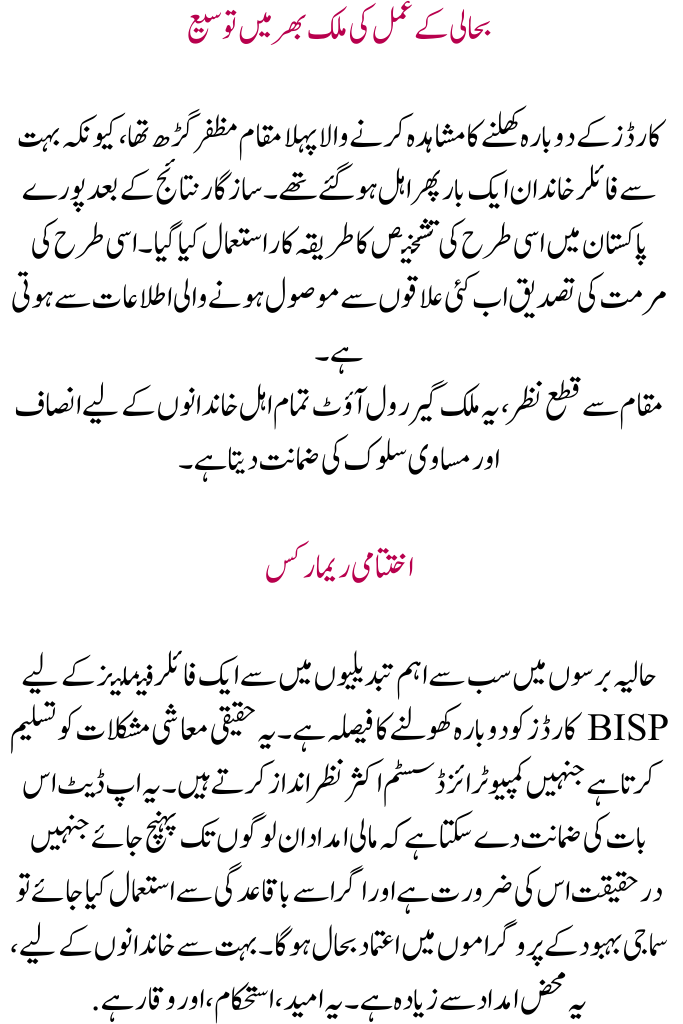
Muzaffargarh was the first place to observe the reopening of cards, since many filer families were once again eligible. The similar evaluation procedure was used throughout Pakistan following favorable outcomes. Similar repairs are now confirmed by reports from several areas.
Regardless of location, this countrywide rollout guarantees justice and equitable treatment for all worthy families.
Concluding Remarks
One of the most significant changes in recent years is the decision to reopen BISP cards for filer families. It acknowledges actual economic hardships that computerized systems frequently overlook. This update can guarantee that financial assistance reaches people who actually need it and rebuild confidence in social welfare programs if it is used regularly. For many families, this is more than simply assistance; it’s hope, stability, and dignity.
You Can Also Read: CM Punjab Naujawan Agriculture Internship Program Phase 2 Launched for Agriculture Graduates
FAQs
1. Why were filer families’ BISP cards blocked?
Automated systems that connected filer status and property data with financial soundness prohibited cards.
2. Do recipients who have been reinstated have to reapply?
No, the majority of cards are automatically revived without requiring a fresh application.
3. When will restored filers’ payments resume?
It is anticipated that restored recipients would begin receiving BISP payments in March 2026.